Empowering Literacy With a Science of Reading Curriculum
Research-Based Instruction to Enrich and Educate

Understanding the Science of Reading
The Science of Reading refers to the body of research that informs the best practices for teaching students how to read. Research shows that reading is a complex process to learn and to teach. For students to become proficient readers, they must be able to recognize written words and understand their meaning, which can be achieved by following a Science of Reading-aligned curriculum.
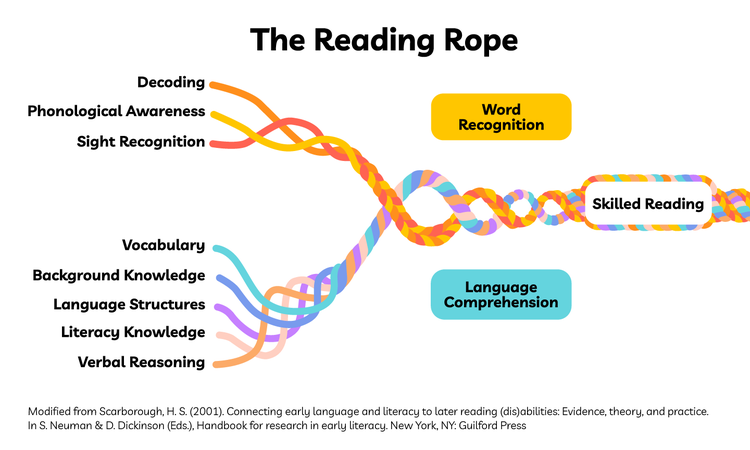
As explained by The Reading Rope, created by Dr. Hollis Scarborough in 2001, the connection between word recognition and language comprehension is what forms the foundation for proficient reading. As you will notice in the image below, Word Recognition is comprised of several strands: Decoding, Phonological Awareness, and Sight Recognition. Language Comprehension involves essential concepts, such as Vocabulary, Background Knowledge, Language Structures, Literacy Knowledge, and Verbal Reasoning. When woven together, all of these strands form the foundation for literacy success, and it all starts with a Science of Reading-based approach.
How Our Reading Curriculum Programs Align With Scientific Research
Choosing a Science of Reading curriculum can be a daunting task. Learning A-Z® makes it easier by ensuring we provide resources that support research-based instruction.
To align with current research, we consider the following:
- The pillars of literacy: Phonemic awareness, phonics, fluency, vocabulary, and comprehension are essential components of an effective literacy curriculum. These pillars drive the ideation, creation, and iteration for our resources.
- Knowledge building: Reading comprehension is connected to the background knowledge students bring to a text. Our rich, complex texts support students in building their world knowledge and acquiring new vocabulary, which increases their understanding of the text and overall comprehension.
- All aspects of literacy: It is not enough for students to develop reading proficiency. Students need access to a vast range of resources that help them become better readers, writers, communicators, and thinkers. Learning A-Z solutions provide a wide variety of learning resources based on Science of Reading research to promote comprehensive literacy.
The Benefits of an Evidence-Based Reading Approach
When combined with well-trained, informed teachers, an evidence-based reading approach ensures that the vast majority of students can achieve reading success. Often referred to as Structured Literacy, this approach to reading instruction emphasizes explicit, systematic instruction that targets students’ unique literacy and learning needs.
Using evidence-based practices, teachers maximize instructional time by modeling skills and strategies through detailed instruction, scaffolding support for students through guided practice, and ensuring that students demonstrate learning through collaborative and independent practice and application.
Science of Reading Curriculum Features: Bridging Theory and Practice
You can feel confident using Learning A-Z resources to supplement your core curriculum, knowing that we have used Science of Reading research to inform instructional practices within our resources. Below you will find a chart detailing how the resources in our various solutions relate to important themes found in a Science of Reading curriculum and examples of applying these concepts.
from explicit, systematic
instruction.
Foundations A-Z
Raz-Plus (includes Foundations A-Z)
Writing A-Z
follows the gradual release approach, so
teachers explicitly model skills and strategies,
provide guided support as students practice
those skills and strategies, and students apply
what they have learned through
independent practice. Several solutions,
including those listed to the left,
include a scope and sequence that builds in complexity
as students work toward proficiency.
skills instruction leads to automatic, skilled reading.
Foundations A-Z
Raz-Plus (includes Foundations A-Z)
Foundations A-Z provides systematic and explicit
foundational skills instruction for K-5 students,
including phonological awareness, print concepts,
fluency, phonics, and word study. Lessons and resources intertwine these discrete skills to help students become skilled, fluent readers.
high-quality writing
instruction support
students as they
demonstrate their
comprehension through writing.
Writing A-Z provides teachers with the tools they
need to help students in grades K-5 acquire the
skills to communicate their ideas. Lessons and resources ensure that students develop
foundational writing skills and strategies that
facilitate communication and help students
understand the texts they read.
connection between
vocabulary development
and reading
comprehension.
Foundations A-Z
Raz-Plus (includes Foundations A-Z)
Vocabulary A-Z
acquire the skills that enable them to determine
the meaning of unfamiliar words and
achieve better overall reading comprehension.
When used in conjunction with the premade
vocabulary lessons in Vocabulary A-Z, Raz-Plus
emphasizes story-critical and academic
vocabulary to help students learn new or
challenging words using high-interest books.
leads to better overall comprehension.
Raz-Plus (includes Foundations A-Z)
Science A-Z
With Learning A-Z, you have the power to create
cross-curricular connections, one book, lesson, or
resource at a time. Science A-Z resources, for
example, blend science and reading instruction,
making it easier to cover both subjects
simultaneously and save time. Unit nonfiction
books, high-interest FOCUS Books, and
Investigation Packs support students in
deepening their scientific
knowledge as they work toward
reading proficiency. In
addition, the social studies content in Raz-Plus
allows you to dissect historical events, act them
out to ensure understanding using
Reader’s Theater, and
promotes deeper
comprehension using close
reading questions.
contributes to reading
success.
Foundations A-Z
Raz-Plus (includes Foundations A-Z)
Science A-Z
Vocabulary A-Z
Writing A-Z
interactive, spaced-theme learning experience.
Students are motivated to complete a variety of
literacy tasks to earn stars and badges that allow
them to customize avatars. They can also check
their individual progress by reviewing their stats.
Fostering a Culture of Science of Reading-Aligned Literacy
Administrators, teachers, students, caregivers, and other school community members must work in tandem to integrate literacy experiences at school and beyond. Students need to see that literacy is an integral part of their learning.
What might fostering a culture of literacy entail? Consider implementing some of the following:
- Host literacy-themed school events
- Provide access to a wide variety of high-quality, high-interest books
- Expand classroom and school libraries to include diverse texts
- Collaborate with colleagues to incorporate literacy instruction across all content areas
- Help students make meaningful connections between reading and writing through well-planned instructional activities
- Set literacy-based goals for teaching and learning
- Develop ways for students to share their reading highlights with their peers
Partnering With Learning A-Z for a Science of Reading Curriculum
Using a Science of Reading curriculum can make a significant impact on literacy development in your classroom. Should you choose to partner with Learning A-Z, you’ll have a wide selection of Science of Reading-aligned solutions to choose from, including Raz-Plus®, our all-in-one K-5 supplemental literacy solution that now includes Foundations A-Z®, and Writing A-Z®, our award-winning solution for K-5 writing instruction.
Here at Learning A-Z, we believe that curious, joyful learners build more proficient literacy skills, which is why our solutions offer a blend of Science of Reading-aligned lessons, resources, professional development, and engaging independent practice opportunities via our student portal. Our resources target students’ needs, engage them with high-interest texts, and help them become fluent readers who comprehend texts. We make it easier for you to implement literacy practices at school, at home, and in the community by providing digital literacy resources that can be accessed anywhere, anytime.
Supplement Your Science of Reading Curriculum
Experience the power of Science of Reading-aligned resources, lessons, professional development, and more with a free trial of Learning A-Z solutions.