The Importance of Frontloading in the Classroom

Actively Preparing Students for Reading to Improve Comprehension
In education, frontloading refers to the work teachers do to prepare students to succeed at academic tasks. When it comes to reading, frontloading is specifically focused on addressing any knowledge demands that a text presents. The purpose is to remove obstacles to comprehension that exist because of a lack of background knowledge or the vocabulary necessary to engage fully with a text. Frontloading provides students with essential information before they read a text, while building background knowledge is a broader process of expanding and deepening students' knowledge base over time.
Effective frontloading requires that teachers understand their individual students’ capabilities and challenges. This article will explore interesting ways to get all students to an equitable entry point before tackling any text.
What Does Effective Frontloading Look Like?
Effective frontloading sessions are exciting for teachers and students. They include discussion, curiosity, and interactivity. The teacher’s role is to spark interest so that students want to keep learning more about the subject—whether it is a grade-level content area or a fictional story set in a faraway place. Here are some ways to create that positive energy.
Brainstorm what a text might be about. Start by reading the title and stating the purpose for reading the text. Then give students some heads-down time to generate ideas regarding what they think they might know about the topic. They will share these ideas with the class.
Try modeling what you are looking for. For a third-grade text titled Animal Discoveries that the class will read to learn about some recently discovered species of animals you can say: “I know that rainforests have lots of animals, but humans haven’t explored all of the areas rainforests cover. Maybe I’ll learn about a new rainforest animal. I know how excited I was when I first heard about pink river dolphins.” You can also use visual devices such as pictures or short videos to boost creative thinking. Make brainstorming fun and more effective by setting some rules:
- All ideas are good ideas.
- This is a “no judgment” zone.
- It’s fine to take shared ideas and expand on them.
Cultivate curiosity. Not knowing much about a topic should not shut down interest in that topic. Rather, help students understand ways to be curious about what they do not yet know. Model sharing your wonderings about topics that are new. For example, regarding a story for second-graders titled The Day It Rained Tortillas, you can say : “I love tortillas, but I am really curious how they might fall from the sky! Guide students to ask open-ended questions rather than yes/no questions, and follow their lead to keep the conversation flowing: “Oh, that is something I would like to learn more about, too!”
Encourage questioning. When students feel comfortable asking questions, they are engaged in what is going on around them. No question is silly; each question deserves a thoughtful response. And when you turn students’ questions into a reason to read, everyone wins! As leading researcher Hugh Catts says, “Knowledge is found inside the reader, not inside the text.” As students grow in knowledge through your effective frontloading, they are free to apply what they know to think deeply while reading.
How Does Building Vocabulary Fit into Frontloading?
Doing prework with keywords found in a text is an important part of effective frontloading. Rather than simply preteaching vocabulary words, shining a spotlight on important terms is best done when interwoven into the sessions described above. For example, a fifth-grade text about the Egyptian pyramids requires knowledge building about this ancient civilization, with part of that involving the introduction of terms particular to its traditions, such as pharaoh, mummification, and sarcophagus. In each case, pictures are invaluable to literally show the items named, with discussion centering around open-ended questions that can get students interested. Pictures that can be projected or projectable books with good illustrations or photographs work well.
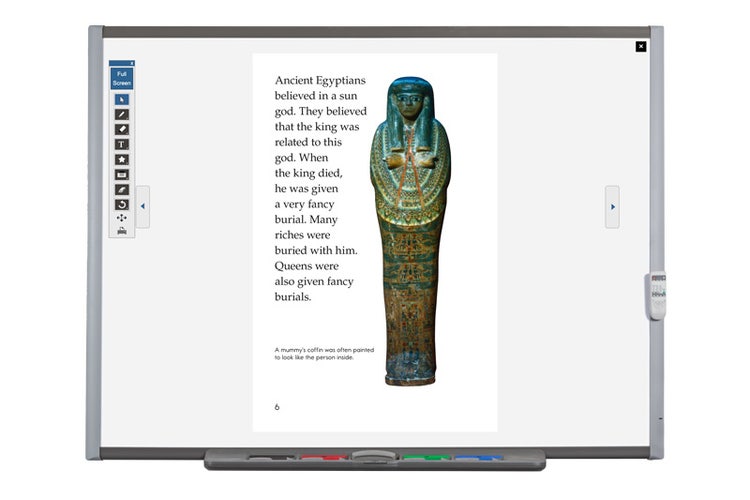
Here’s an example of how a frontloading session with embedded vocabulary instruction might go. As each word is introduced, it should be written for students to see, and they should say it back and then begin naturally using it in their responses to the questions posed.
- Pharaohs were rulers who Egyptians thought were gods related to the most important god of all–the Sun god. When Pharaohs died on Earth, they were thought to go back to their lives with the Sun god. So they weren’t really dead. That’s why the pyramids, where their bodies were placed, had to include everything the Pharaohs would need in the afterlife. How big do you think a pyramid would have to be to include everything the very rich Pharaohs were used to having? If you look at this picture of a pyramid, you can see camels. These animals are about the size of large horses. They look tiny next to the pyramid. What do you think was used to build the pyramid?
- Look at all the sand in the desert where the pyramid was built. What does this tell you? Do you think this is why the Egyptians thought the Sun god was the most important god of all? What types of things do you think Pharaohs would choose to have placed in their pyramids?
- Here is a picture of the large coffin where one Pharaoh’s body was placed inside a pyramid. It is called a sarcophagus. Look how fancy it is, to show off the wealth of the Pharaoh. Remember that the Egyptians didn’t think Pharaohs really died? They used a process called mummification that preserved the body for thousands of years. So inside this sarcophagus is a mummified body. Would you like to see that? Have you ever seen a television show or movie about mummies? What did you think?
Note that this way of introducing vocabulary words as part of frontloading eliminates the idea that it should all be “teacher talk.” The teacher’s role is to explore with the students, to listen, and to provide information in engaging ways that lead to interactivity. Part of the interactivity leads to students using the new terms themselves.
Why Has Frontloading Become Increasingly Important in Elementary Classrooms?
Several factors have led to the uptick in the need for frontloading. As our education system continues to recover from the COVID-19 pandemic, many students do not meet grade-level expectations for reading, with content area knowledge and vocabulary among the areas in which they show gaps. Frontloading helps to fill in the missing pieces for students so they are better prepared to engage with any text.
The increased emphasis on adhering to research-based practices with fidelity has led more and more schools and districts to adopt core reading programs. These programs are often built around authentic anchor texts, which are selected by publishers because they are rich in content. However, educators find that students have little knowledge about the topics of these texts and quickly become lost or disengaged as a result. Since an anchor text is often at the center of instruction for up to one month of the school year, it is imperative to capture students’ interest and make them feel successful from day one with the text. Teachers find that taking the time to do effective frontloading makes these curricula more successful. In addition to employing the frontloading sessions described above, educators also turn to other texts on the same topics, written for specific grade levels.
The need to fill learning gaps in both reading and math following the pandemic has resulted in reduced time spent on social studies and science in the elementary grades. This means that students are not getting the same instruction in these subject areas as before. Yet, the texts selected for reading programs still tend to assume students will have familiarity with the topics. As a result, without frontloading, students face a much bigger cognitive load in trying to both master the content area knowledge and experience gains in reading. High-quality multimedia tools can help fill these knowledge gaps quickly by allowing students to learn by listening and watching. So digital companies–including entities such as museums and research facilities willing to invest in outreach to children–are spending more of their budgets crafting such solutions.
How Can Teachers Find the Time to Include Frontloading in Reading Instruction?
One of the biggest pain points for today’s elementary educators is time. Perhaps the most commonly heard complaint is that there never seems to be enough time to do what needs to be done every day in the classroom. The demands on teachers are great, so each time a new practice is suggested for adoption, it feels overwhelming.
The fact is that introducing frontloading as a classroom routine will save time–time that is currently spent catching students up when they become disengaged from a text that overwhelms them. Frontloading saves time because it embraces and engages everyone in the classroom, not just some students. That gives the teacher time back that would otherwise be spent with small groups of learners while other students must work independently. And that is time that creates a more equitable experience for all.
Perhaps educator and author Regie Routman said it best with these words: “The better job we do preparing students to do a task (frontloading), the more independently students–even our youngest ones–are able to work and problem solve and produce better quality work.” This describes what we all want: students moving joyfully forward on their learning journey.
DIVIDER
Try the tools teachers trust— ++for free{sunny-yellow}++
Start exploring Raz-Plus today with free samples you can begin using in your classroom right away.
Get a sneak peek at:
- Decodable books and phonics skill packs
- Vocabulary and comprehension resources
- Tools for building metacognition and independent reading habits
https://go.learninga-z.com/l/710503/2025-05-28/lnvfr{height:175px}