Tips for Leveraging the Power of Graphic Organizers in Your Classroom

Have you ever provided a student with a graphic organizer before they began reading, feeling confident it would help them navigate the text and support their comprehension, only to find that it didn't go as planned? Maybe the student recorded irrelevant details, or perhaps they chose not to use it at all. You know that graphic organizers are valuable tools, so you're left wondering what you could do differently next time.
These moments can be difficult, but they also highlight an incredible opportunity to change our students' experiences with graphic organizers. Imagine turning these challenges into a chance to enhance your students' reading comprehension and engagement. By refining your approach, you can help students unlock the full potential of this tool.
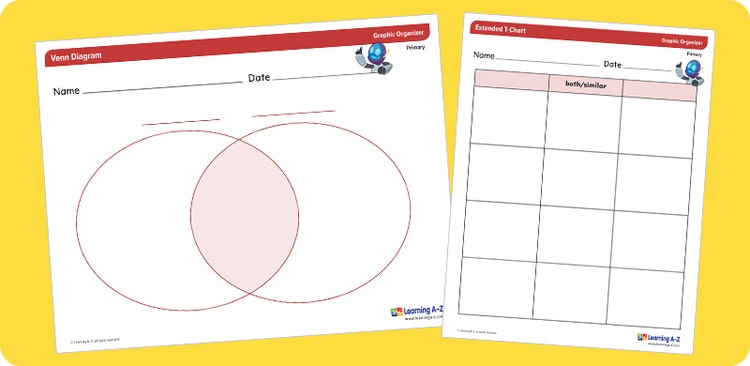
Graphic organizers, such as matrices, tables, and Venn diagrams, visually represent organizational structures in a text, like cause-and-effect, sequencing, or comparison. These tools help readers uncover meaning by logically organizing details, making the relationships between ideas easier to see. Most importantly, graphic organizers serve as scaffolds, or temporary supports, that foster equitable literacy practices. In other words, they make complex text accessible to all readers when needed. Here are tips for improving the effectiveness of using graphic organizers for reading.
Establish a Clear Purpose for Reading
A purpose for reading is a specific goal or focus that guides a reader's attention and helps them engage with the text more effectively. You might be wondering how this connects to using a graphic organizer. Think of a purpose for reading as a road map: the purpose is the final destination, and the details captured on graphic organizers will lead us there. Therefore, it is important to consider if the graphic organizer you choose to use aligns with your purpose for reading. For example, if you are reading to “compare two characters in a story to gain a deeper understanding of each of the characters,” then a Venn Diagram would be an ideal choice to illustrate the comparison.
The purpose can also help us offer guidance to a student. If you notice your student is looking at their text and their graphic organizer with a furrowed brow, they might have lost sight of their purpose. Use this as an opportunity to encourage the student to revisit their goal for reading. For instance, you might say, “I see your purpose for reading today is to learn more about ways to save the coral reef. Did the author provide any suggestions in this section that are worth recording? Where does it make sense to capture this on your graphic organizer? Jot a few words to remember this idea that the author provided you.”
Model How to Get the Most Out of Graphic Organizers
Despite their intuitive design, students benefit greatly from seeing their teachers explicitly model how to use graphic organizers to support text comprehension. Here are a few tips to enhance this modeling process. Demonstrate how a reader interacts with both the text and the graphic organizer by reading small chunks and then returning to the organizer to reflect on what has been read. This back-and-forth process helps scaffold the reader's understanding. Use clear and explicit language such as, “I want to remember … so I will record…” or “The text says … therefore, I am thinking/wondering..." This teaches students to slow down and think about the text rather than merely copying details without connecting them to their thoughts.
The goal of modeling is to make your internal reading dialogue visible, encouraging students to replicate these metacognitive processes on their own. Lastly, don’t underestimate the power of students watching you fill out a graphic organizer and involving them in the decision-making process of what to capture. These experiences build confidence and proficiency when students use these tools independently. Consider using a projectable version of a graphic organizer so all students can watch closely as you model. The projectable tools can also help you color-code details or highlight big ideas you have uncovered in real time, making it a dynamic and engaging experience for students.
Unlock the Power of Graphic Organizers as a Tool
Simply having students fill out a graphic organizer is not enough to support their comprehension. It's crucial that they also practice retrieving the information they've captured to demonstrate their understanding of a text. You can accomplish this by providing students with opportunities to respond to their purpose for reading by using their graphic organizers. This process requires students to recall what they have read, combine ideas, and draw conclusions—essential skills for any reader to develop. Responding to their purpose can be accomplished in various ways, like through writing a summary of what they’ve read, orally sharing with peers or the class, or even making an audio recording of their responses for their teacher. The key is for students to see the value of this work and understand how it strengthens their understanding of a text. If they view it as just another worksheet or assignment, they might not see the benefit of using this valuable tool.
By refining your approach to using graphic organizers, you can transform these tools into powerful aids for reading comprehension and engagement. Remember, the key is to establish clear purposes for reading, model their use explicitly, and provide opportunities to retrieve the ideas they have captured. With these strategies, you can help your students navigate complex texts with confidence and develop essential reading skills that will serve them well throughout their academic journey. Embrace the opportunity to unlock the power of graphic organizers and make them a valuable part of your literacy instruction.
DIVIDER
Try the tools teachers trust— ++for free{sunny-yellow}++
Start exploring Raz-Plus today with free samples you can begin using in your classroom right away.
Get a sneak peek at:
- Decodable books and phonics skill packs
- Vocabulary and comprehension resources
- Tools for building metacognition and independent reading habits
https://go.learninga-z.com/l/710503/2025-05-28/lnvfr{height:175px}
References:
- Dunston, Pamela J., and Andrew M. Tyminski. The Impact of Graphic Organizer and Metacognitive Monitoring Instruction on Expository Science Text Comprehension in Fifth Grade Students. North Carolina State University, 2013. https://repository.lib.ncsu.edu/items/7a3bc0e8-c6a0-4602-b7e9-d6df394cbdac.
- Hennessy, Nancy. The Reading Comprehension Blueprint: Helping Students Make Meaning from Text. Brookes Publishing, 2013.
- Zimmerman, Barry J. “Becoming a Self-Regulated Learner: An Overview.” Theory into Practice, vol. 41, no. 2, 2002, pp. 64–70. https://doi.org/10.1207/s15430421tip4102_2.
- Cummins, Sunday. Close Reading of Informational Sources: Assessment-Driven Instruction in Grades 3–8. 2nd ed., The Guilford Press, 2019.