Support the
++Science of Reading{optimistic-orange}++
with Raz-Plus
Select each section of the Reading Rope to learn how the resources in Raz-Plus align and help teachers foster both Word Recognition and Language Comprehension for all K-5 students.

++The Reading Rope{optimistic-orange}++
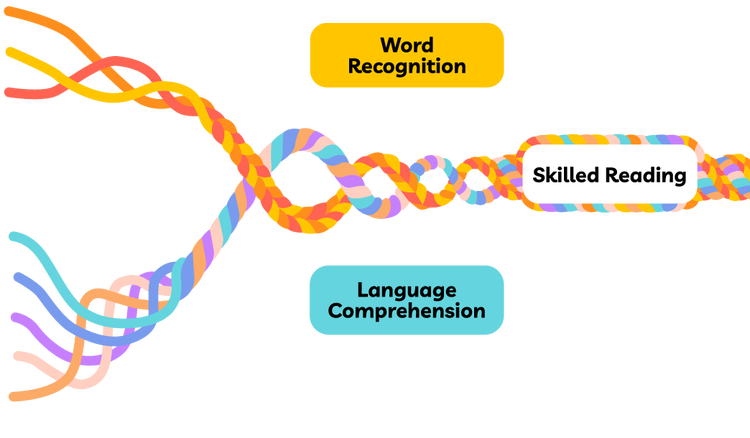
Modified from Scarborough, H. S. (2001). Connecting early language and literacy to later reading (dis)abilities: Evidence, theory, and practice. In S. Neuman & D. Dickinson (Eds.), Handbook for research in early literacy. New York, NY: Guilford Press
++Word Recognition{sunny-yellow}++
{optimistic-orange}
++Decoding{sunny-yellow}++
The ability to apply one’s knowledge of letter-sound relationships, including knowledge of letter patterns, to correctly pronounce written words.
- Phonics Lesson Packs
- Systematic, sequential, explicit, multi-sensory curriculum
- 32 weeks per grade (K-2)
- Direct instruction with decoding words in isolation prior to reading words in the decodable
- Encoding in addition to decoding
- Over 100 packs that focus on individual skills within a scope and sequence
- Decodable Books
- Sound/Symbol Books
- Alphabet Books
- Alphabet Chants
- Phonics Classroom Center Activities
- Phonics Assessments
{warm-white}
++Phonological Awareness{sunny-yellow}++
The ability to recognize and work with sounds in spoken language.
- Phonological Awareness Lesson Packs
- 32 weeks of systematic sequential lessons (K-1)
- Built-in complexity horizontally within a grade and vertically across grades
- Phonological Awareness Classroom Center Activities
- Phonological Awareness Assessments
{radiant-red}
++Sight Recognition{sunny-yellow}++
The ability to know a word by sight without having to decode it. Sight Recognition includes knowing a word’s meaning in context.
++Language Comprehension{joyful-aqua}++
{joyful-aqua}
++Vocabulary{sunny-yellow}++
Working on Vocabulary includes learning the meanings of words, understanding the connection between words, and using words to express understanding.
{positive-periwinkle}
++Background Knowledge{sunny-yellow}++
Refers to facts, concepts, and experiences specific to situations and information presented in text or during a discussion.
{enthusiastic-purple}
++Language Structures{sunny-yellow}++
Refers to syntax and semantics. Syntax speaks to a language system that has everything to do with how word order is used to convey meaning. Semantics is about the way words are used to convey meaning.
{happy-pink}
++Literacy Knowledge{sunny-yellow}++
Refers to the understanding of how conventions, patterns, and organization are all used to convey meaning in print, including the idea that different genres serve different purposes in terms of conveying ideas.
{warm-white}
++Verbal Reasoning{sunny-yellow}++
Involves students thinking deeply about texts while also thinking outside of the text to draw inferences and integrate information. It also requires Background Knowledge and understanding of language structures.